Weekend fishing outlook
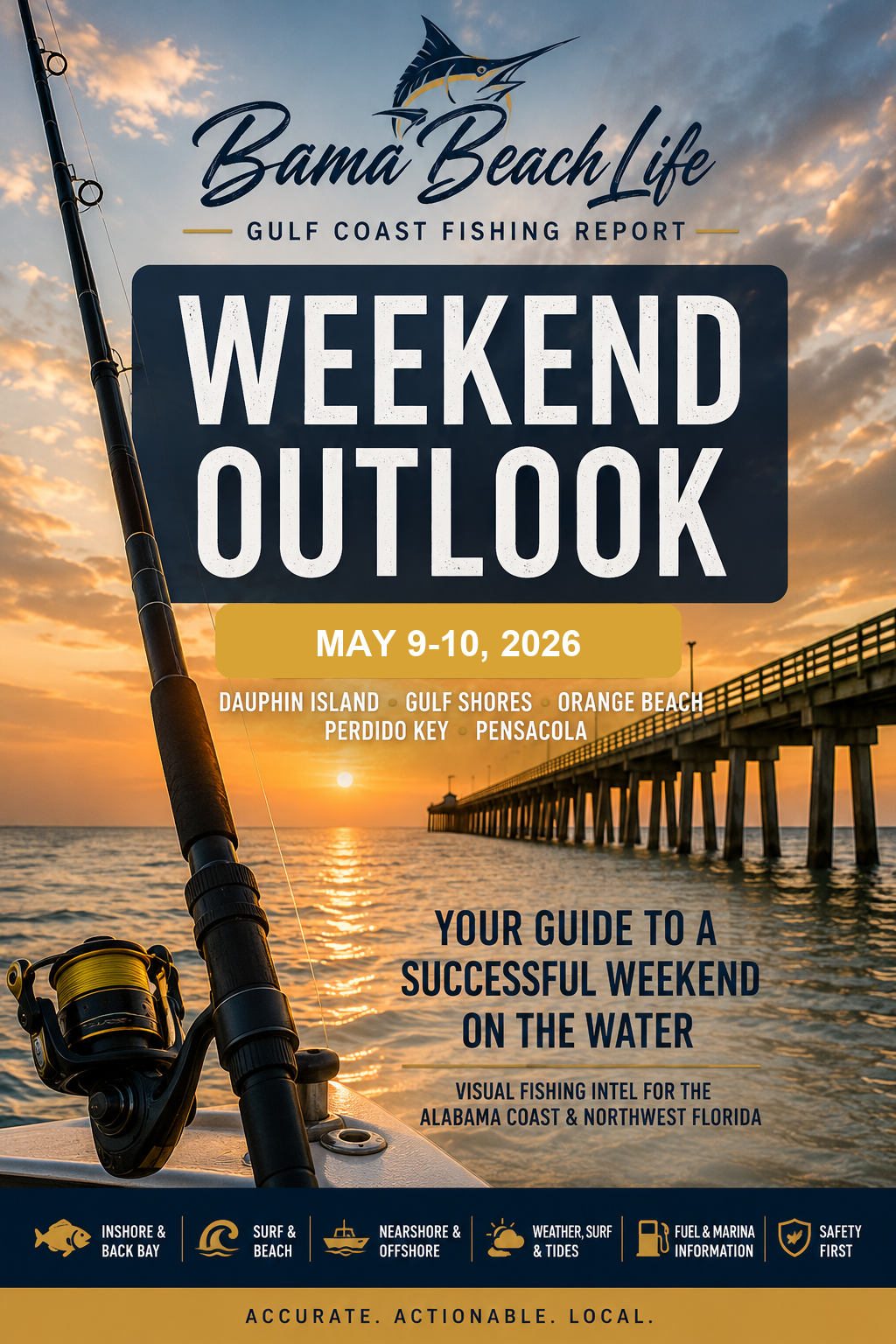
Coverage: Dauphin Island • Gulf Shores • Orange Beach • Perdido Key • Pensacola
Quick Answers
What is the best bite this weekend?
Inshore trout, redfish, and flounder are the strongest overall bite.
Where does this report apply?
This weekly fishing report covers Dauphin Island • Gulf Shores • Orange Beach • Perdido Key • Pensacola.
What should surf anglers watch?
Whiting and flounder are the steadier Alabama surf targets; pompano are possible but inconsistent.
Is offshore fishing worth it?
Offshore bottom fishing is a good option around beeliners, scamp, and triggerfish.
Gulf Coast Fishing Report - May 9-10, 2026
30-Second Fishing Brief
Use Saturday and Sunday as the planning window and let the live marine forecast decide how far you run. If storms, dirty water, or higher seas show up, shift toward protected water early. Trout, redfish, and flounder remain strong inshore options around grass, shell, docks, rocks, potholes, and protected shorelines. On the beach, whiting and flounder are the dependable starting points, with pompano possible where the water is clean. Nearshore Spanish mackerel are worth checking around bait, birds, passes, and jetties. Offshore bottom fishing is worth a look around offshore structure.
This Week’s Fishing Game Plan
Build the trip in layers so you can adjust quickly if the weekend forecast changes. Start with the safest fishable water, then move up only when the Gulf, surf, and radar support it.
- Plan A: Protected inshore water. Fish grass, shell, docks, potholes, rocks, drop-offs, bay structure, and protected shorelines for trout, redfish, and flounder.
- Plan B: Beach fishing. Start with whiting and flounder. Add pompano only when the water is clean, grass is manageable, and you can find bait or moving water.
- Plan C: Nearshore Spanish mackerel. Watch birds, bait, jetties, tide movement, and current seams. This is a better short-window option than a long offshore gamble.
- Plan D: Offshore bottom fishing. Save this for a real weather window. Check storms, wind, seas, and fuel range before running far.
What’s Working This Week
This week’s best information points to a few practical patterns. Use these as starting points, then adjust based on weather, water clarity, tide movement, and bait.
- Inshore trout, redfish, and flounder are the strongest overall targets.
- Whiting and flounder are the steadier Alabama surf targets; pompano are possible but inconsistent.
- Spanish mackerel are the strongest nearshore action bite.
- Offshore bottom fishing is a good option around beeliners, scamp, and triggerfish.
- Check radar, wind, and buoy observations before making a longer run.
Inshore / Back Bay
- The inshore plan is steady this week. Trout, redfish, and flounder give you multiple ways to catch fish, while the beach and Gulf options also look playable this weekend.
- For trout and redfish, start around grass beds, oyster shell, docks, potholes, rocks, drop-offs, creek mouths, bay structure, and protected shorelines. Look for bait flipping, birds working, slicks, nervous water, and current pushing across structure.
- Early and late light can help, especially for trout. Topwater can be a good search tool, but if fish slap at it and miss, switch to soft plastics, jigs, shrimp, or a popping cork.
- For flounder, slow down. Fish sandy cuts, washouts, dock edges, bridge edges, grass/sand transitions, and spots where current pushes bait along the bottom. A slow jig, live bait, or shrimp near the bottom is easier for an angler than trying to cover water too fast.
- If the wind makes one shoreline dirty or rough, move to the protected side. Clean water, bait, and manageable current matter more than forcing a famous spot.
Surf & Beach
- The beach plan should start with whiting and flounder because they are more forgiving than pompano. An angler can catch whiting with a simple double-drop rig, small hooks, fresh dead shrimp, Fishbites, or small pieces of natural bait.
- Fish the first trough first. That is the deeper lane just off the beach where waves wash back out. You do not always need to cast far. Many beach fish feed close if the water has enough depth and movement.
- For flounder, look for washouts, cuts in the sandbar, corners of sandbars, pier or jetty edges, and areas where water is draining back off the beach. Keep the bait near the bottom and work it slowly.
- Pompano are possible, but inconsistent. Better pompano water is usually cleaner green water with some movement, not muddy brown water. Look for sand fleas, coquina, ghost shrimp, small crabs, or other bait in the wash. Fishbites, shrimp, sand fleas, ghost shrimp, and small crab pieces can all work.
- If the surf is full of grass, your bait will not stay clean. Move down the beach, shorten the cast, fish heavier weight, or switch to a simpler whiting/flounder plan.
- If there is a moderate rip-current risk, do not wade deep to cast. Fish from dry sand or shallow water and stay away from jetties, piers, cuts, and fast-moving water if you are not experienced.
Nearshore
- Spanish mackerel are the main nearshore fish to watch. They are fast, aggressive, and often show around bait schools, birds, jetties, passes, current seams, and nearshore structure.
- Good signs are noisy, erratic birds diving on bait, bait showering on the surface, small fish skipping, clean green water, and current moving around a point, pass, jetty, or structure.
- Good easy-to-use lures include spoons, Got-Cha style plugs, small jigs, bucktails, and fast-moving shiny baits. Retrieve quickly. Spanish mackerel often react to speed.
- Spanish mackerel have sharp teeth. After a strike or after landing a fish, run your fingers along the leader. If it feels rough, curled, or nicked, cut it back and retie before the next cast. A nicked leader can break on the next fish.
- Nearshore is a short-window plan. If storms start building or the wind switches against the tide, do not wait for the Gulf to get worse before heading back in.
Offshore
- The offshore plan is bottom fishing first. Beeliners, scamp, triggerfish, grouper, and snapper-type reef fish were all part of the offshore picture in this week’s information.
- Live bait matters offshore, especially around ships, rigs, reefs, wrecks, and bottom structure. If bait is hard to find or the current is wrong, the offshore plan gets harder quickly.
- Swordfish are a strong but specialized deep-water option. That is not a casual trip plan. It takes specialized electronics, tackle, bait, and weather knowledge.
- Offshore species to plan around this week include red snapper, amberjack, beeliners, scamp, triggerfish, grouper, swordfish, tuna, yellowfin tuna, blackfin tuna, cobia, and king mackerel. Build the trip around the right depth, structure, and current sign.
- Tuna and cobia should usually be treated as bonus or specialized fish unless the week’s conditions, bait, and reports clearly support building the whole trip around them.
Tides & Timing
Use tide movement to choose when to be in position. Moving water pushes bait, sets up current seams, and makes structure easier to fish. Plan to be on your spot before the best tide window starts instead of arriving after the water has already quit moving.
- Pensacola: best high-water planning windows are Saturday around 4:21 PM; Sunday around 5:10 PM.
- Pensacola: low-water turns are Saturday around 3:20 AM; Sunday around 3:36 AM.
- Alabama Point / Orange Beach: best high-water planning windows are Saturday around 2:31 PM; Sunday around 3:22 PM.
- Alabama Point / Orange Beach: low-water turns are Saturday around 2:04 AM; Sunday around 2:11 AM.
- Gulf Shores ICW: best high-water planning windows are Saturday around 5:11 PM; Sunday around 5:55 PM.
- Gulf Shores ICW: low-water turns are Saturday around 4:06 AM; Sunday around 4:21 AM.
- For trout, redfish, and flounder, be set up before the water starts moving. Fish grass edges, docks, rocks, potholes, shell, cuts, and shoreline current while the tide is moving.
- For beach fishing, the hour or two around moving water is usually better than dead slack water. Watch troughs, cuts, sandbar corners, and places where bait is being pushed.
Weekend Weather
The weather section should decide where you fish before the species list does. Pick the safest fishable water first, then adjust the fishing plan around storms, wind, surf, and water clarity.
- Use the Saturday and Sunday forecast as the planning window, not old weekday weather.
- Compare the forecast with live radar, wind, and buoy observations before making a longer run.
- If storms build or the water gets dirty, protected inshore water becomes the better backup plan.
Weekend Weather Forecast
Weather data from NOAA/NWS.
Marine Safety Watch
Use this as a practical reminder, not a scare section. The goal is to make it home with the same people and boat you left with.
- Recent boating and water-rescue stories around the Gulf Coast are a reminder that trouble usually starts when people push marginal conditions, underestimate storms, or fail to prepare the boat.
- Before leaving the dock, check life jackets, bilge pump, navigation lights, VHF or charged phone, anchor, first-aid kit, throwable device, fuel range, and weather radar.
- Tell someone where you are going and when you expect to be back. That simple step matters if you break down, get caught by weather, or lose phone service.
- Small boats should be especially careful with long open-water runs when scattered thunderstorms are possible. A good bite is not worth getting trapped outside a safe return window.
- Beach anglers should respect rip currents even when surf looks manageable. Stay out of fast cuts, deeper channels, and water moving hard near jetties, piers, or sandbar breaks.
Boating Safety Headlines This Week
- Orange Beach offshore rescue: Four people were rescued after a boat capsized offshore. The lesson is simple — a Gulf run can turn serious quickly if a boat takes on water, flips, or loses power away from help.
- Pensacola Beach boat rescue: A family and dog were rescued from a partially submerged boat. Check bilge pumps, batteries, flotation, and communication before leaving the dock.
- Pensacola boat fire: A speed boat caught fire near Three Mile Bridge. Fire extinguishers, battery condition, fuel-system checks, and a way to call for help matter every trip.
- Gulf Breeze overboard incident: Reports included recovery efforts after a man fell from a boat. Wearable life jackets, kill switches, and staying seated in rough or shifting conditions matter.
Fuel & Marina Notes
Fuel and marina information is included for trip planning. Prices change often, and some posted prices are more than 7 days old or do not show an update date. Call the fuel dock before making a long run just to save a few cents per gallon.
Lowest Listed Gas
- $4.900 — Homeport Marina (Gulf Shores) — posted price is more than 7 days old
- $5.199 — Legendary Marina and Yacht Club (Gulf Shores) — posted on the marina site during this week’s run
- $5.269 — Reel Surprise Marina (Orange Beach) — no update date shown
- $5.359 — Legendary Marina and Yacht Club (Gulf Shores) — posted on the marina site during this week’s run
- $5.400 — Bear Point Harbor (Orange Beach) — listed price is 4–7 days old
Lowest Listed Diesel
- $5.299 — Legendary Marina and Yacht Club (Gulf Shores) — posted on the marina site during this week’s run
- $5.340 — Barber Marina (Elberta / Perdido backwater) — listed price is 4–7 days old
- $5.437 — Reel Surprise Marina (Orange Beach) — no update date shown
- $5.500 — Homeport Marina (Gulf Shores) — posted price is more than 7 days old
- $5.500 — Bear Point Harbor (Orange Beach) — listed price is 4–7 days old
Call the marina to check prices due to the price not being current:
- $4.900 — Homeport Marina (Gulf Shores) — posted price is more than 7 days old
- $5.269 — Reel Surprise Marina (Orange Beach) — no update date shown
- $5.437 — Reel Surprise Marina (Orange Beach) — no update date shown
- $5.500 — Homeport Marina (Gulf Shores) — posted price is more than 7 days old
Angler Playbook
- Pick one main plan and one backup plan before leaving. Do not try to chase every fish in the report in one trip.
- For inshore trout and redfish, bring soft plastics, jig heads, popping corks, shrimp, and a topwater plug for low light.
- For flounder, fish slower and closer to the bottom. Work sandy edges, washouts, dock edges, and current seams.
- For the beach, bring small hooks, pyramid sinkers, Fishbites, shrimp, sand-flea style baits, pompano rigs, and enough tackle to move if grass ruins the first spot.
- For whiting, do not overcast. Fish the first trough and small depth changes close to shore.
- For pompano, look for clean green water, bait in the wash, lighter grass, and water moving through a cut or trough.
- For Spanish mackerel, bring spoons, Got-Cha style plugs, bucktails, small jigs, and extra leader material.
- If mackerel are striking short or cutting you off, check the leader after every hit and retie when it feels rough.
- For offshore bottom fishing, check storms, seas, and current conditions before making the run.
- Pack a simple safety kit: life jackets, charged phone, VHF if available, first aid, pliers, knife, flashlight, water, and a way to anchor.
- Check the tide before choosing a start time. Try to fish moving water instead of dead slack water.
- Check radar before the first cast and again before making a longer run.
- If a spot has no bait, no current, dirty water, and no signs of life, move.
- If the surf is full of grass, switch beaches, shorten the cast, fish heavier weight, or change to an inshore plan.
- The best fishermen adjust early. Do not wait half the day to admit the first plan is not working.
Bottom Line
This is a flexible weekend, but live conditions still matter. Start with the cleanest, safest water available and adjust before the day gets away from you.
Bama Beach Life — Gulf Coast Fishing Report
Fishing, weather, surf, fuel, and boating conditions change quickly. Check current forecasts, tides, and marina details before making a trip.
Watch video → Listen to podcast →
Sponsor This Weekly Report
Reach anglers planning trips from Dauphin Island to Pensacola with a weekly placement built for local businesses.
Learn more →